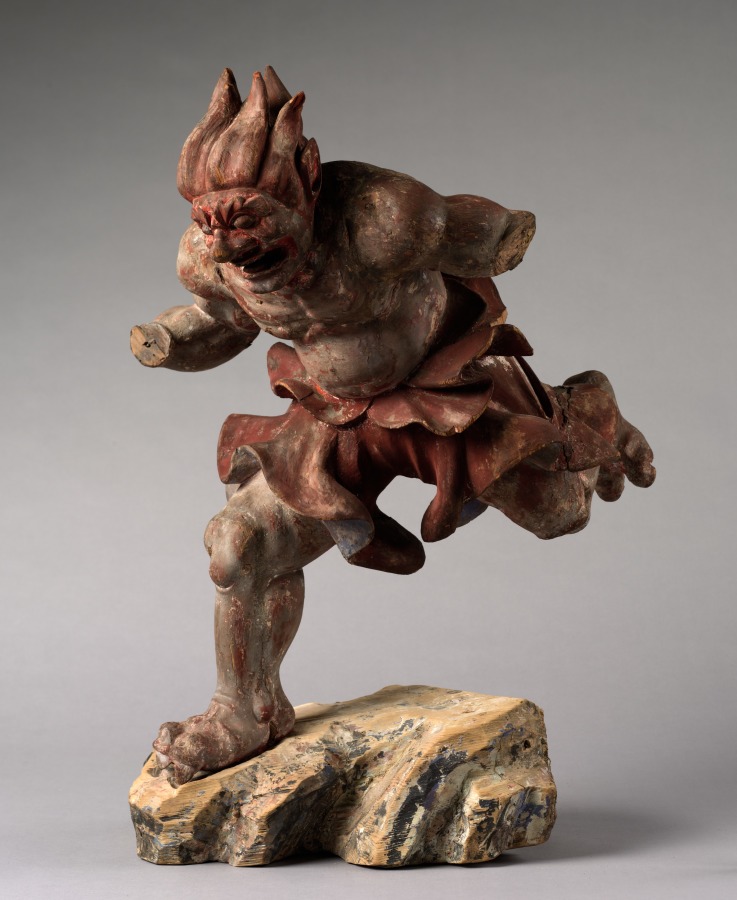
Thunder God (Raijin)
Je k vidění?
Momentálně není vystaveno
Kde je teď „Thunder God (Raijin)“? Sbírka: Clevelandské muzeum umění, Cleveland. Momentálně není vystaveno. Ověřeno 9. listopadu 2026.

Cleveland, Spojené státy americké
Patří do sbírky, ale momentálně není vystaveno.
- Ověřeno
- Tento stav platí od
- Zdroj
- Muzeum
O soše
A metal fitting on Thunder God (Raijin), a fourteenth-century sculpture in the Cleveland Museum of Art, Cleveland, once held a circle of little drums. Raijin strikes these with a stick to make thunder. The Japanese and Chinese Buddhist figures of thunder and wind gods developed from Indian imagery of demons trying to disturb the meditating Shakyamuni. Their airborne attacks tested his concentration. This statue’s companion, the wind god Fujin, is now in Japan’s Fukuoka Art Museum, while the drum attachment survives on Raijin’s back.
Slovy muzea
The Thunder (Raijin) and Wind (Fujin) gods first appeared in early Buddhist art in China and Japan and were based on the popular imagery in India that was derived from the life of the historical Buddha, Shakyamuni. They were shown among a group of demon-monsters flying through the sky above the meditating Shakyamuni in an attempt to frighten away his concentration. Raijin is surrounded by a ring of small drums struck by a stick held in his hand so that he is always accompanied by a thunderous noise. A metal clasp protruding from this sculptures' back indicates that a ring of drums was once attached to the Cleveland Raijin. The matching sculpture, Fujin, is in the Fukuoka Art Museum in Japan.
Clevelandské muzeum umění
Podrobnosti
- Inventární číslo
- 1972.64
V katalogu
Zdroje
- Clevelandské muzeum umění
- Obrázek: Clevelandské muzeum umění — Museum open access