 Martin SchongauerNěmecko, 1440–1491
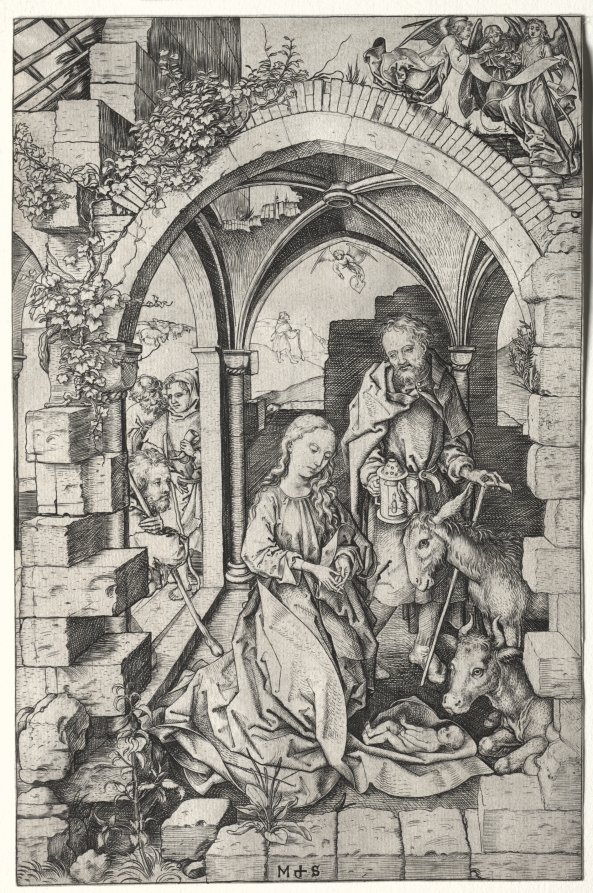
The Nativity
Je k vidění?
Momentálně není vystaveno
Kde je teď „The Nativity“? Sbírka: Clevelandské muzeum umění, Cleveland. Momentálně není vystaveno. Ověřeno 9. listopadu 2026.

Cleveland, Spojené státy americké
Patří do sbírky, ale momentálně není vystaveno.
- Ověřeno
- Tento stav platí od
- Zdroj
- Muzeum
O díle
Martin Schongauer placed the Nativity inside a ruined Gothic building in his engraving of 1470–75, now in the Cleveland Museum of Art, Cleveland. Mary prays over the infant lying on a corner of her cloak on the ground. Joseph carries a lantern and looks towards her; an ox and donkey stand nearby. Angels sing above the broken vaults, while three shepherds watch through an archway. Farther away, an angel announces the birth to a shepherd. This was the first of four surviving engravings thought to form an unfinished cycle of Mary’s life.
Slovy muzea
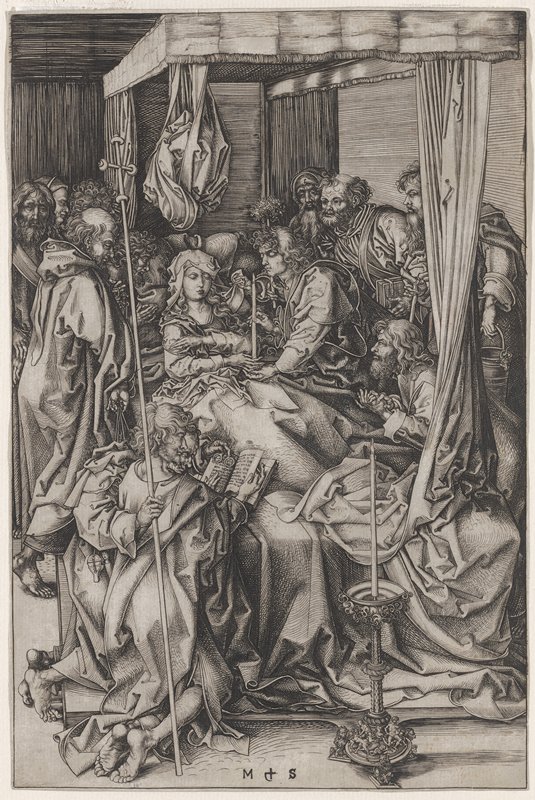
This print of the Nativity is the first of a set of four engravings considered to be an incomplete series of episodes of the Life of the Virgin, which also includes the Adoration of the Magi (1942.1070), The flight into Egypt (1954.260), and The Death of the Virgin (1956.744). Here, Martin Schongauer portrayed the humble and private joy of the Virgin Mary in prayer as she adores the holy infant, who lies on the ground on a corner of her cloak. Joseph gazes tenderly at his wife and holds a lantern. The holy family is joined by the ox and the donkey. The scene takes place in the ruins of a vaulted Gothic edifice, from the top of which jubilant angels sing. From the arched entrance, three shepherds witness the nativity. In the distance, an angel heralds the miraculous birth to one of the shepherds.
Clevelandské muzeum umění
Podrobnosti
- Inventární číslo
- 1939.448
V katalogu
Zdroje
- Clevelandské muzeum umění
- Obrázek: Clevelandské muzeum umění — Museum open access
V životě: Martin Schongauer
Celý životopisc. 1466 – 1469
Learns painting from Caspar Isenmann
After early training in his father’s goldsmith workshop, he is thought to have learned painting from Colmar’s leading master Caspar Isenmann, a neighbour of his parents and a follower of Early Netherlandish painting. The older view that Master E. S. taught him engraving is now doubted by scholars.
not after 1469
Journeyman travels through Burgundy and the Netherlands
He makes the journeyman’s tour expected of artists of his time, begun by 1469 at the latest: he visits Burgundy and the Netherlands and gets to know the work of Rogier van der Weyden, Dirk Bouts, the Cologne school around Stefan Lochner and the Flemish school of Jan van Eyck. He is thought to have worked for a time with Hans Pleydenwurff in Nuremberg, and some scholars believe he also visited Spain, perhaps Portugal.
1469
Back in Colmar
Having finished his travels, he is recorded back in Colmar in 1469.
early 1470s
Begins signing his engravings with a monogram
He is thought to have begun signing his engravings with the monogram M†S in the early 1470s; 116 engravings are attributed to him, and none of them is dated.
1471
Sets up his own workshop in Colmar
By 1471 he has his own workshop: that year payments are made for an altarpiece for the Dominican church in Colmar, now in the museum and regarded as a workshop production.
c. 1471 – 1491
Twenty years at the head of German engraving
He dominates German engraving for about twenty years: his 116 engravings are known in Germany and Italy, reach England and Spain, and in Italy their maker is nicknamed “Beautiful Martin”; according to Vasari, Michelangelo copied his Temptation of St Anthony.