Edgar DegasFrancie, 1834–1917
The Milliners
Je k vidění?
Ano, právě vystaveno
Kde je teď „The Milliners“? Muzeum J. Paula Gettyho, Museum West Pavilion, Gallery W204, Los Angeles. Ano, právě vystaveno. Ověřeno 5. října 2026.
Zavřeno· otevírá v 10:00
Veřejně vystaveno.
- Ověřeno
- Tento stav platí od
- Zdroj
- Muzeum
O obrazu
Edgar Degas depicts two hat-makers in The Milliners, dated about 1882–before 1905 and kept at the J. Paul Getty Museum in Los Angeles. Their table cuts sharply across the room, crowded with dark hat stands that partly conceal them. The woman at right concentrates on a hat. Her older colleague holds pink fabric but looks beyond the picture, apparently absorbed in troubling thoughts. Bright ribbons contrast with the workers' dull surroundings. The older woman's thin body and pale skin convey strenuous work for little reward. The canvas hangs in W204.
Slovy muzea
Two milliners sit at a dramatically angled worktable, their bodies partly obscured by the shadowed hat stands that crowd their work space. Seen as little more than a silhouette, the figure at right works carefully on a hat. Her attentiveness is not shared by her older counterpart who, though grasping a swath of pink fabric, appears lost in thought, gazing beyond the frame with a disquieting expression. The brightly colored ribbons--pink, yellow, orange, and green--draw attention to the drabness of the room and its inhabitants. Over the course of about thirty years, Edgar Degas produced more than twenty paintings, pastels, and drawings of millinery shops. Among modern painters, Degas alone depicted this subject matter with such frequency. His voyeuristic yet empathetic portrait of the milliner's private world focuses on the physical hardship of their work. The woman at the left embodies the painter's concern; even at rest, her wiry body and pallid skin registers a life of hard work and meager reward.
Muzeum J. Paula Gettyho
Podrobnosti
- Inventární číslo
- 2005.14
V katalogu
Zdroje
- Muzeum J. Paula Gettyho
- Obrázek: Muzeum J. Paula Gettyho — Open Content
V životě: Edgar Degas
Celý životopisautumn 1879 – April 1880
The prints journal: Degas abruptly withdraws
In the autumn and winter of 1879–1880 Degas and Cassatt worked closely together on a prints journal; he owned a small printing press. In April 1880 Degas abruptly withdrew, and without his support the project folded.
by 1880
The end of his financial crisis
By 1880 Degas had fully overcome his financial crisis and become a respected figure in the Paris art world; the Impressionist exhibitions, which proved commercially useful to him, helped.
1881
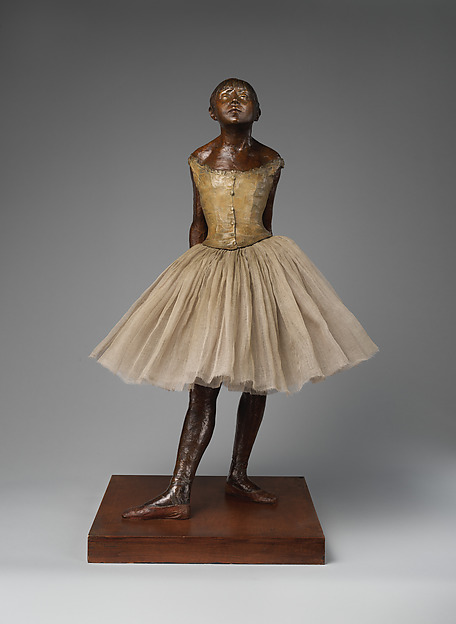
“The Little Dancer of Fourteen Years” on show
The nearly life-size wax figure with real hair and a cloth tutu, modelled on Marie van Goethem, provoked a strong reaction: critics found its realism extraordinary, but many denounced the dancer as ugly. It was the only sculpture Degas showed in his lifetime.
by 1882
His eyesight sharply worsens
By 1882 Degas's eyesight began to worsen sharply: he turned to pastel and then to sculpture, where he could rely more on touch.
1886
The eighth exhibition: pastel nudes, and the end of the group
At the last Impressionist exhibition Degas showed a suite of pastel nudes, which drew more critical writing than anything else in his lifetime, mostly laudatory. The group broke up, partly through rancour over the inclusion of non-Impressionists such as Forain and Raffaëlli.
1890s
The Dreyfus Affair: a break with his Jewish friends
The Dreyfus Affair intensified Degas's antisemitism: by the mid-1890s he had broken with all his Jewish friends and refused to use models he thought might be Jewish; the affair also set him at odds with Mary Cassatt. He remained among the Anti-Dreyfusards until his death.