Edgar DegasFrancie, 1834–1917
The Bow
Je k vidění?
Momentálně není vystaveno
Kde je teď „The Bow“? Sbírka: Národní galerie ve Washingtonu, Washington, D.C. Momentálně není vystaveno. Ověřeno 2. listopadu 2026.

Washington, D.C., Spojené státy americké
Patří do sbírky, ale momentálně není vystaveno.
- Ověřeno
- Tento stav platí od
- Zdroj
- Muzeum
O soše
The Bow by Edgar Degas dates to the 1880s/1890s and is in Washington, at the National Gallery of Art. The nude figure bends forward, supported by a metal armature within pigmented beeswax. Marks left in the wax remain visible across the surface. Without its wooden base, this sculpture stands 32.5 centimeters high, with a depth of 19.4 centimeters.
Podrobnosti
- Inventární číslo
- 1985.64.50
Co zobrazuje
V katalogu
Zdroje
- Národní galerie ve Washingtonu
- Obrázek: Národní galerie ve Washingtonu — Museum open access
V životě: Edgar Degas
Celý životopisautumn 1879 – April 1880
The prints journal: Degas abruptly withdraws
In the autumn and winter of 1879–1880 Degas and Cassatt worked closely together on a prints journal; he owned a small printing press. In April 1880 Degas abruptly withdrew, and without his support the project folded.
by 1880
The end of his financial crisis
By 1880 Degas had fully overcome his financial crisis and become a respected figure in the Paris art world; the Impressionist exhibitions, which proved commercially useful to him, helped.
1881
“The Little Dancer of Fourteen Years” on show
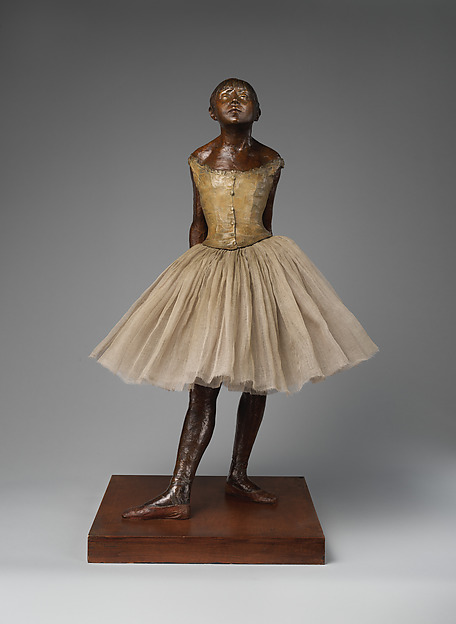
The nearly life-size wax figure with real hair and a cloth tutu, modelled on Marie van Goethem, provoked a strong reaction: critics found its realism extraordinary, but many denounced the dancer as ugly. It was the only sculpture Degas showed in his lifetime.
by 1882
His eyesight sharply worsens
By 1882 Degas's eyesight began to worsen sharply: he turned to pastel and then to sculpture, where he could rely more on touch.
1886
The eighth exhibition: pastel nudes, and the end of the group
At the last Impressionist exhibition Degas showed a suite of pastel nudes, which drew more critical writing than anything else in his lifetime, mostly laudatory. The group broke up, partly through rancour over the inclusion of non-Impressionists such as Forain and Raffaëlli.
1890s
The Dreyfus Affair: a break with his Jewish friends
The Dreyfus Affair intensified Degas's antisemitism: by the mid-1890s he had broken with all his Jewish friends and refused to use models he thought might be Jewish; the affair also set him at odds with Mary Cassatt. He remained among the Anti-Dreyfusards until his death.