Vasily KandinskyFrancie, 1866–1944
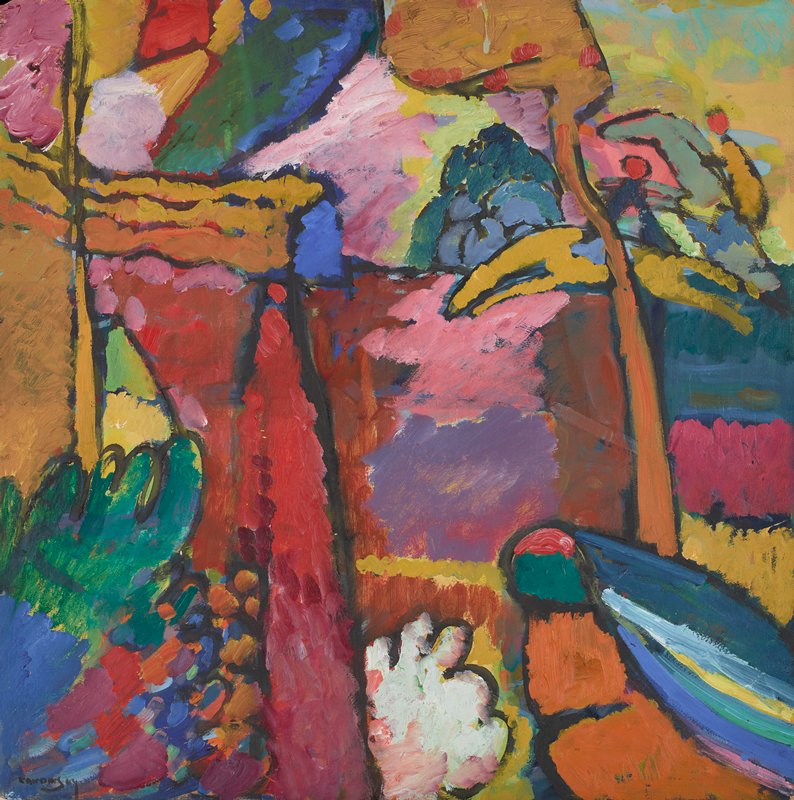
Study for Small Joys
Je k vidění?
Nevíme
Kde je teď „Study for Small Joys“? Sbírka: Musée national d’art moderne, Paříž. Zda je dnes vystaveno, nevíme.
Paříž, Francie
Vlastník je znám, dnešní vystavení nikoli.
- Tento stav platí od
- Zdroj
- Muzeum
O obrazu
In his 1913 Study for Small Joys, Wassily Kandinsky drew more freely than in the finished painting; the study belongs to the Musée national d’Art moderne, Paris. Scattered coloured marks almost conceal a hilltop citadel, a flying rider, a rowing boat and two reclining figures. He worked in watercolour and India ink on paper. A pencilled inscription on the mount identifies the sheet as a watercolour for Small Joys.
Podrobnosti
- Inventární číslo
- AM 81-65-243
V katalogu
Zdroje
- Wikidata
- Obrázek: Musée national d’art moderne — Wassily Kandinsky · Public domain · Wikimedia Commons
V životě: Vasily Kandinsky
Celý životopis1910–1911
The treatise “Concerning the Spiritual in Art”
The treatise defended and promoted abstract art and affirmed that all forms of art are equally capable of reaching spirituality; colour in a painting can be autonomous, apart from the depiction of an object. Kandinsky distinguished three kinds of painting: impressions, improvisations and compositions.
1910–1912
The Izdebsky Salons and the Knave of Diamonds
With the Neue Künstlervereinigung Kandinsky took part in two international Izdebsky Salons in Russian cities, from December 1910 to May 1911; in 1910 and 1912 he also exhibited with the Knave of Diamonds.
1911
The birth of the Blue Rider
After the earlier association dissolved Kandinsky formed the Blue Rider with August Macke, Franz Marc, Albert Bloch and Gabriele Münter. The group issued an almanac and held two exhibitions; the war ended further plans.
1911
His first solo exhibition
His first solo exhibition took place in the same years, when the Blue Rider was being born.
1911
Divorce from his first wife
Kandinsky was divorced from Anna Chemyakina; his relationship with Münter was nevertheless never formalized.
1914
The war: back to Russia via Switzerland and Sweden
The outbreak of World War I ended the Blue Rider's plans for further almanacs and exhibitions and sent Kandinsky back to Russia via Switzerland and Sweden; he returned to Moscow in 1914.