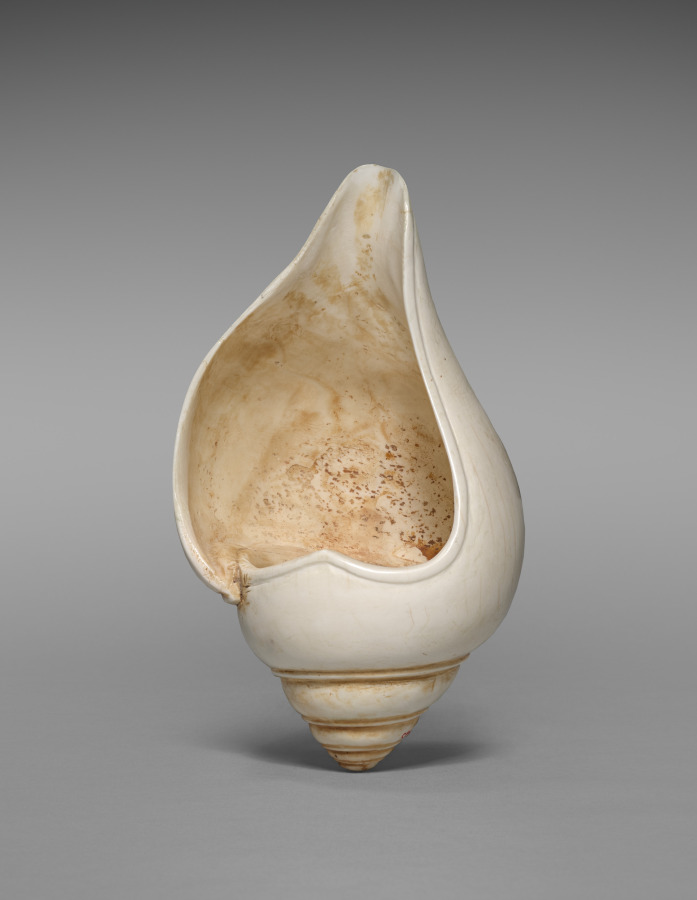
Ritual conch shell
Je k vidění?
Momentálně není vystaveno
Kde je teď „Ritual conch shell“? Sbírka: Clevelandské muzeum umění, Cleveland. Momentálně není vystaveno. Ověřeno 9. listopadu 2026.

Cleveland, Spojené státy americké
Patří do sbírky, ale momentálně není vystaveno.
- Ověřeno
- Tento stav platí od
- Zdroj
- Muzeum
O soše
A dancing Hevajra appears in the bronze fittings of this twelfth-century Cambodian Ritual Conch Shell, now in the Cleveland Museum of Art, Cleveland. His sixteen arms, four legs and eight heads identify a Buddhist figure central to Angkorian ritual practice associated with the Hevajra-tantra. Blowing a conch opened ceremonies with a sound corresponding to om. Royal temples performed such rites for the kingdom’s protection and prosperity. The three-legged support formed from serpents probably did not originally belong to this shell.
Slovy muzea
A royal temple like Banteay Chhmar was built for performing rituals and to honor images of gods, Buddhas, and other sacred or enlightened beings for the sake of the kingdom’s protection and ongoing prosperity. Conch shells were blown at the start of rituals to make the sound corresponding to the syllable om.
The dancing figure of Hevajra, a Buddhist being of enlightenment with eight heads, sixteen arms, and four legs, has been worked into the bronze embellishment of the shell. Hevajra was elevated to a prominent position in Khmer Buddhism of the Angkorian period as the standard figure denoting the practice of rituals prescribed in a text called the Hevajra-tantra. The tripod stand with three serpents is probably not original to the shell.
Clevelandské muzeum umění
Podrobnosti
- Inventární číslo
- 1977.176.c
V katalogu
Zdroje
- Clevelandské muzeum umění
- Obrázek: Clevelandské muzeum umění — Museum open access