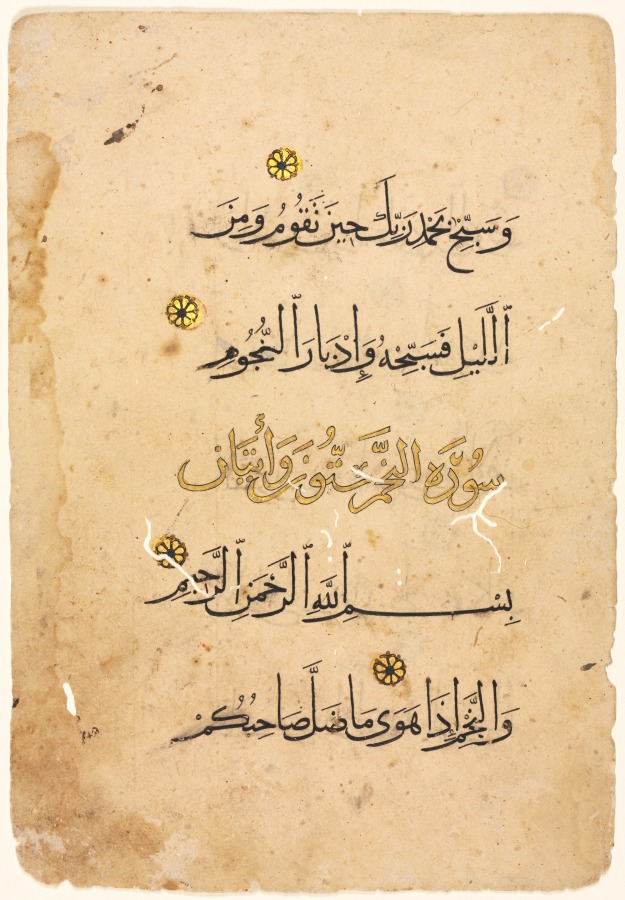
Qur'an Manuscript Folio
Je k vidění?
Momentálně není vystaveno
Kde je teď „Qur'an Manuscript Folio“? Sbírka: Clevelandské muzeum umění, Cleveland. Momentálně není vystaveno. Ověřeno 9. listopadu 2026.

Cleveland, Spojené státy americké
Patří do sbírky, ale momentálně není vystaveno.
- Ověřeno
- Tento stav platí od
- Zdroj
- Muzeum
O díle
Verses from the Star chapter occupy Qur’an Manuscript Folio, a fourteenth- or fifteenth-century leaf in the Cleveland Museum of Art, Cleveland. This is the Qur’an’s fifty-third chapter, known in Arabic as An-Najm. Arabic revelation to Muhammad in the seventh century gave the written language a central place in Islamic art and raised the standing of calligraphy. Beautiful writing was not confined to scripture, however. Calligraphic inscriptions also appeared on objects made for secular settings, extending the practice beyond copies of religious texts.
Slovy muzea
It is through the Arabic language that the Qur’an was revealed to the Prophet Muhammad in the 600s. As a result, calligraphy is celebrated as the highest form in Islamic art. The verses (ayat) written here come from the 53rd chapter (surah) of the Qur’an, also known as the Surah An-Najm, the Chapter of the Star. The significance of the Qur’an provides an explanation for the importance of calligraphy, but its use was not restricted to religious texts. Many objects in the museum's Islamic collection bear calligraphic inscriptions and come from secular contexts, displaying the versatility and creativity of this art form.
Clevelandské muzeum umění
Podrobnosti
- Inventární číslo
- 1933.474
V katalogu
Zdroje
- Clevelandské muzeum umění
- Obrázek: Clevelandské muzeum umění — Museum open access