 Honoré DaumierFrancie, 1808–1879
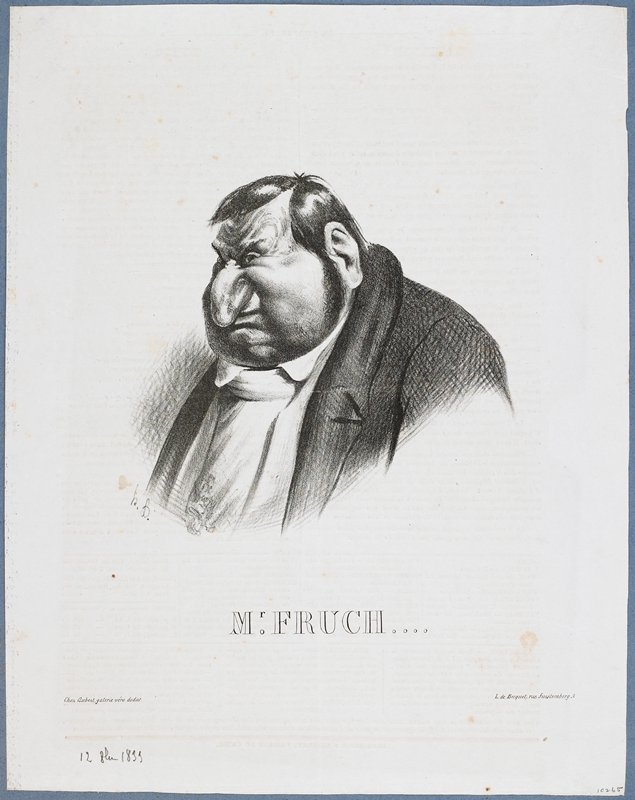
Mr. Fruch
Je k vidění?
Momentálně není vystaveno
Kde je teď „Mr. Fruch“? Sbírka: Minneapoliský institut umění, Minneapolis. Momentálně není vystaveno. Ověřeno 9. listopadu 2026.

Minneapolis, Spojené státy americké
Patří do sbírky, ale momentálně není vystaveno.
- Ověřeno
- Tento stav platí od
- Zdroj
- Muzeum
O díle
Deputy Jean-Marie Fruchard (1788-1872) has a place in history thanks to Daumier's entertaining caricature. This lithograph is based on a small portrait bust Daumier made from clay as he watched the debates in the Legislative Assembly. The print takes the caricature much further, accentuating Fruchard's prominent nose by having it hang over his lips.
Minneapoliský institut umění
Podrobnosti
- Inventární číslo
- P.10, 265
V katalogu
Zdroje
- Minneapoliský institut umění
- Obrázek: Minneapoliský institut umění — public domain
V životě: Honoré Daumier
Celý životopis1829–1831
First Notable Works in La Silhouette
Daumier's first significant works appeared in La Silhouette, France's first illustrated satirical weekly, published from December 1829 to January 1831.
1831
Publication of the Caricature "Gargantua"
In December 1831 Daumier's caricature of King Louis-Philippe, "Gargantua," was published, bringing him widespread notoriety and criminal prosecution.
1832
Trial for Insulting the King
In February 1832 Daumier stood trial on charges of "inciting hatred and contempt for the government and insulting the king" and was sentenced to six months in prison and a fine of 500 francs; execution of the sentence was deferred.
1832
Arrest and Imprisonment at Sainte-Pélagie
In August 1832 Daumier was arrested at his parents' apartment and placed in the Sainte-Pélagie prison to serve his six-month sentence; in prison he remained defiant and continued to draw "to spite the government." His imprisonment brought him considerable fame.
1834
Closure of La Caricature; Move to Le Charivari
In 1834 La Caricature collapsed under the weight of the monarchy's prosecutions and fines; Daumier continued working for Philipon's journal Le Charivari, founded in December 1832, where he published scenes from "The Adventures of Robert Macaire" and other series.
1835
The "September Laws" Restricted Press Freedom
After an assassination attempt on Louis-Philippe, the "September Laws" were enacted, imposing harsh fines and prison terms for criticizing the king; Daumier's caricatures softened and turned to satire of the bourgeoisie and everyday Parisian life.