Emil NoldeNěmecko, Dánsko, 1867–1956
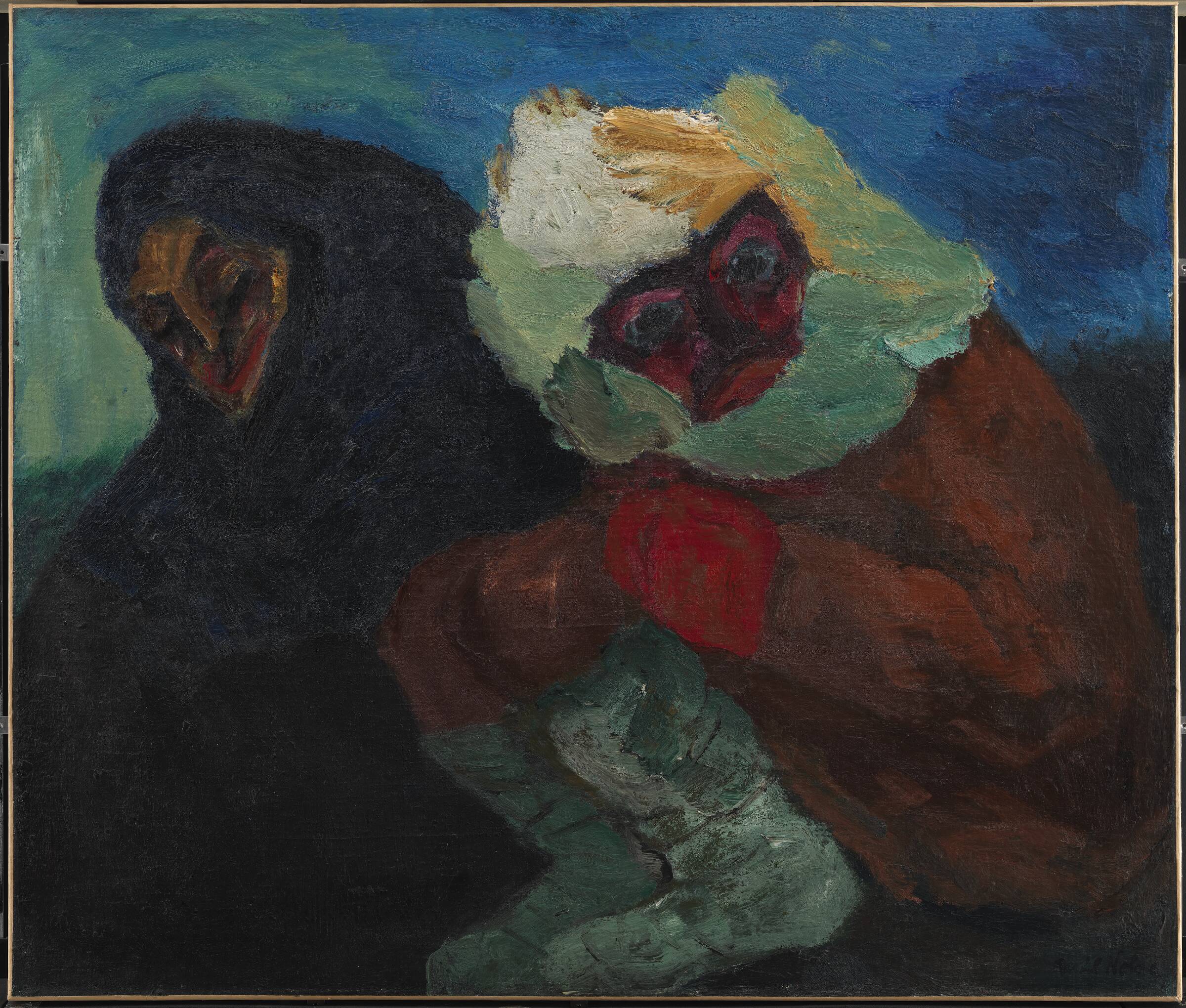
Mann und Weibchen
Je k vidění?
Momentálně není vystaveno
Kde je teď „Mann und Weibchen“? Sbírka: Minneapoliský institut umění, Minneapolis. Momentálně není vystaveno. Ověřeno 2. listopadu 2026.

Minneapolis, Spojené státy americké
Patří do sbírky, ale momentálně není vystaveno.
- Ověřeno
- Tento stav platí od
- Zdroj
- Muzeum
O díle
In this bold image, Expressionist Emil Nolde melds technique and subject as a means to escape the stifling regimentation Imperial Germany. Like several other artists of his time, his search for purity led him to so-called primitive cultures, here represented by two figures half-clothed in boldly-patterned cloth seated beneath a starry sky. Rather than carving supple lines, as he had been trained to do in his youth, Nolde hacked at the woodblock to give the image an uncivilized feel. This work thus taps into many issues currently debated in the art world: What is the role of exoticism? Who gets to work in what style to tell whose story? What is the role and limitation of the stereotype? How do we of the present deal with the art of the past?
Minneapoliský institut umění
Podrobnosti
- Inventární číslo
- 2019.34
V katalogu
Zdroje
- Minneapoliský institut umění
- Obrázek: Minneapoliský institut umění — © Minneapolis Institute of Art
V životě: Emil Nolde
Celý životopis1908 – 17. prosince 1910 · Členství
Berlin Secession
1910
Expelled from the Berlin Secession
In 1910, after a disagreement with the leadership, Nolde was expelled from the Berlin Secession, of which he had been a member since 1908.
1910–1912
First success at exhibitions in Hamburg, Essen and Hagen
In 1910–12 Nolde had his first success at exhibitions in Hamburg, Essen and Hagen.
1912
Exhibits with Kandinsky’s Blaue Reiter
In 1912 Nolde exhibited with Wassily Kandinsky’s Munich-based group Der Blaue Reiter; by then he had achieved some fame and could support himself through his art.
1913–1914
An expedition to New Guinea by way of Russia and Asia
In 1913–14 Nolde travelled to the Southern Hemisphere as a member of the Medical-Demographic German New Guinea Expedition of the Imperial Colonial Office; a famous series of his paintings covers the journey, with the South Seas, Moscow, Siberia, Korea, Japan and China.
1913–1914 · Působiště
German New Guinea