Maurits Cornelis EscherNizozemsko, 1898–1972
Liberation
Je k vidění?
Momentálně není vystaveno
Kde je teď „Liberation“? Sbírka: Národní galerie ve Washingtonu, Washington, D.C. Momentálně není vystaveno. Ověřeno 2. listopadu 2026.

Washington, D.C., Spojené státy americké
Patří do sbírky, ale momentálně není vystaveno.
- Ověřeno
- Tento stav platí od
- Zdroj
- Muzeum
O díle
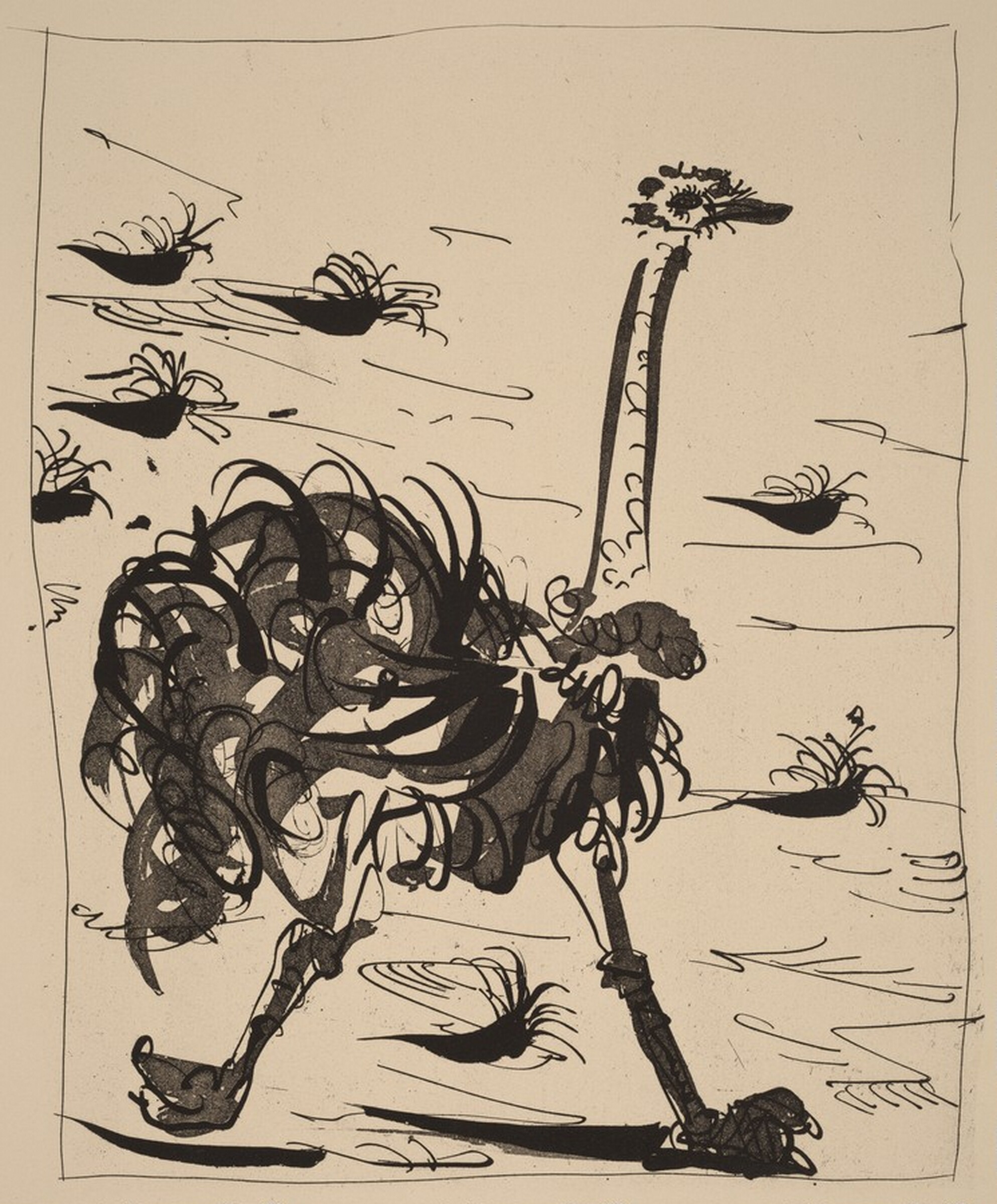
Liberation, dated 1955, is a lithograph by M. C. Escher held in Washington at the National Gallery of Art. Birds and geometric forms share its narrow vertical composition. The image measures about 43.7 centimetres high and 19.7 wide, within a sheet roughly 53 by 31.3 centimetres. This impression came from Cornelius Van S. Roosevelt.
Podrobnosti
- Inventární číslo
- 1974.28.56
Co zobrazuje
V katalogu
Zdroje
- Národní galerie ve Washingtonu
- Obrázek: Národní galerie ve Washingtonu — © the artist or rights holder
V životě: Maurits Cornelis Escher
Celý životopis1954
An exhibition for the Mathematical Congress
In 1954, for the International Congress of Mathematicians in Amsterdam, an exhibition of Escher’s work organised by N. G. de Bruijn opened at the Stedelijk Museum; Roger Penrose and H. S. M. Coxeter were deeply impressed by his intuitive grasp of mathematics. The exhibition took up so much time that in 1954 Escher made only two works.
27 April 1955
Knight of the Order of Orange-Nassau
On 27 April 1955 Escher was made a Knight (fifth class) of the Order of Orange-Nassau; in 1967 Queen Juliana raised him to the rank of Officer.
1956–1960
The Penroses and “impossible figures”
“House of Stairs” (1951) attracted the interest of the mathematician Roger Penrose and his father, the biologist Lionel Penrose; in 1956 they published a paper on impossible objects and later sent Escher a copy. He replied, admiring their continuously rising flights of steps, and enclosed a print of “Ascending and Descending” (1960); he went on to use the Penrose triangle repeatedly, notably in “Waterfall” (1961).
1957–1959
Coxeter and “Circle Limit”
In 1957 the geometer Donald Coxeter, with Escher’s permission, used two of his drawings in a paper on crystal symmetry and sent him a copy; the figure of a hyperbolic tessellation, with tiles shrinking rapidly towards the edge of a circle, “gave him quite a shock” — here was a way to represent infinity on a plane. He called his experiments “Coxetering”; they gave the series of wood engravings “Circle Limit I–IV”, and in 1959 Coxeter concluded that they were accurate to the millimetre.