Alexander CalderSpojené státy americké, 1898–1976
Fourth Flurry '48
Je k vidění?
Nevíme
Kde je teď „Fourth Flurry '48“? Sbírka: Galerie umění Yaleovy univerzity, New Haven. Zda je dnes vystaveno, nevíme.
New Haven, Spojené státy americké
Vlastník je znám, dnešní vystavení nikoli.
- Tento stav platí od
- Zdroj
- Muzeum
O soše
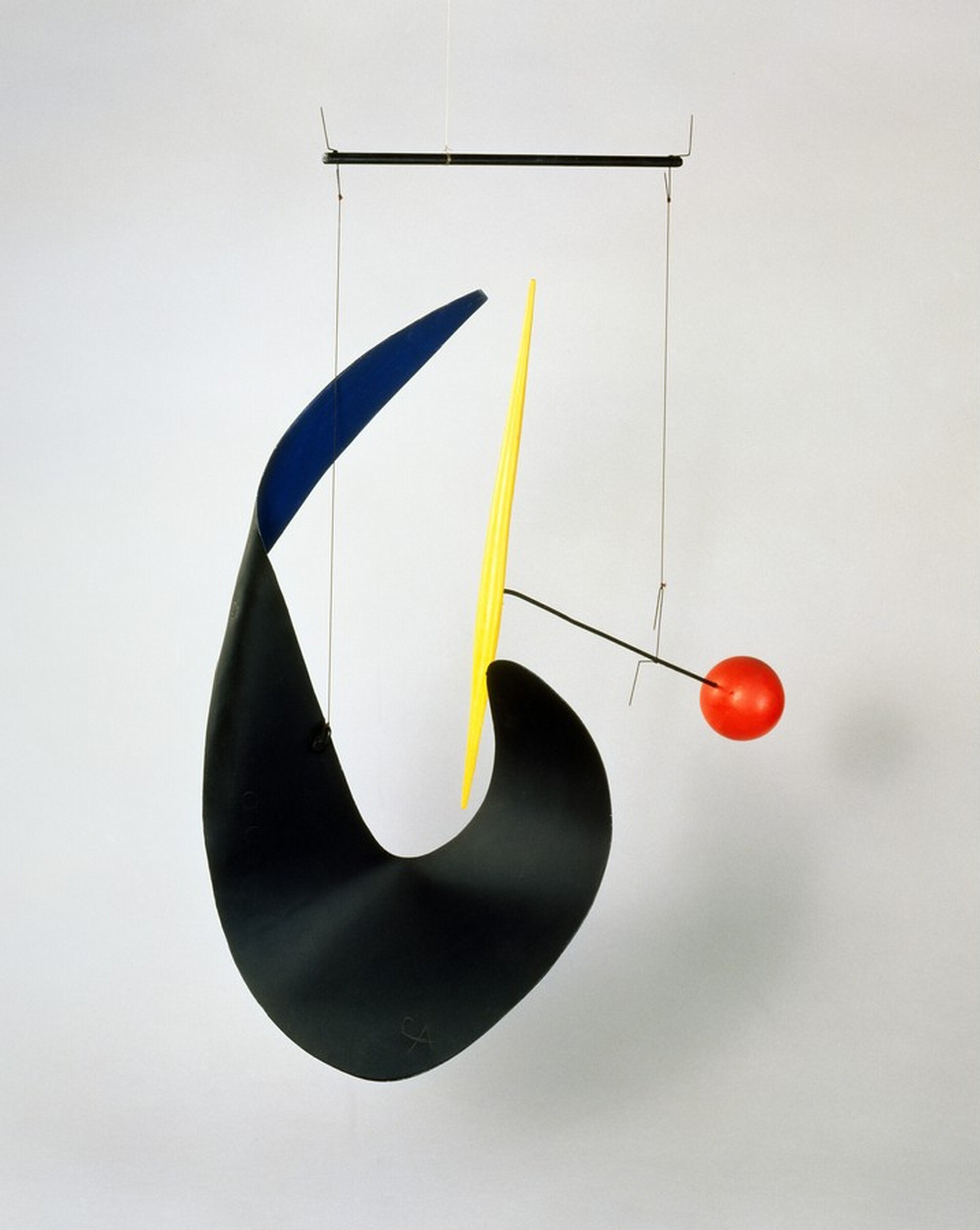
This three-dimensional work consists of approximately thirty white discs of graduated size attached to metal wires of various weights and lengths. This type of suspended sculpture is known as a "mobile," the term that Marcel Duchamp suggested for Alexander Calder's unique form of sculpture that moved in response to natural forces. Fourth Flurry '48 sways and shifts in response to air currents and the counterbalances of gravity, creating a constantly changing, asymmetrical yet balanced composition. Looking up at the slowly moving sculpture, the viewer is presented with a sensation evocative of a wide variety of natural forms and systems in motion, from snowflakes to solar systems, from atoms to galaxies. At the same time, this airy graceful sculpture functions on purely abstract terms. The white circular shapes, which create a rhythm through their repetition, are juxtaposed with the black-painted wire lines, creating a whimsical, abstract drawing in space.
Galerie umění Yaleovy univerzity
Podrobnosti
- Inventární číslo
- 1948.298
V katalogu
Zdroje
- Galerie umění Yaleovy univerzity
- Obrázek: Galerie umění Yaleovy univerzity — Image: Yale University Art Gallery · In Copyright
V životě: Alexander Calder
Celý životopis1946
The Louis Carré show and Sartre’s essay
In 1946 a Calder show organised by Duchamp, made up mainly of hanging and standing mobiles, opens at Galerie Louis Carré in Paris; because of the postal service’s strict size limits he takes some works apart and sends them by mail. The show makes a huge impact, as does the catalogue essay by Jean-Paul Sartre.
1948
A Rio de Janeiro show nearly sells out
By 1948 Calder’s works are selling: his solo show in Rio de Janeiro nearly sells out, and he becomes the first internationally renowned sculptor.
summer 1949
“Sculpture International” in Philadelphia
In the summer of 1949 Calder is one of 250 sculptors in the 3rd Sculpture International at the Philadelphia Museum of Art; his “International Mobile” is the centrepiece of the exhibition.
1950
Galerie Maeght becomes his Paris dealer
From 1950 Galerie Maeght in Paris is Calder’s exclusive Parisian dealer for the rest of his life. Both of his dealers, Galerie Maeght in Paris and later the Perls Galleries in New York, averaged about one Calder show each per year.