Paul KleeNěmecko, 1879–1940
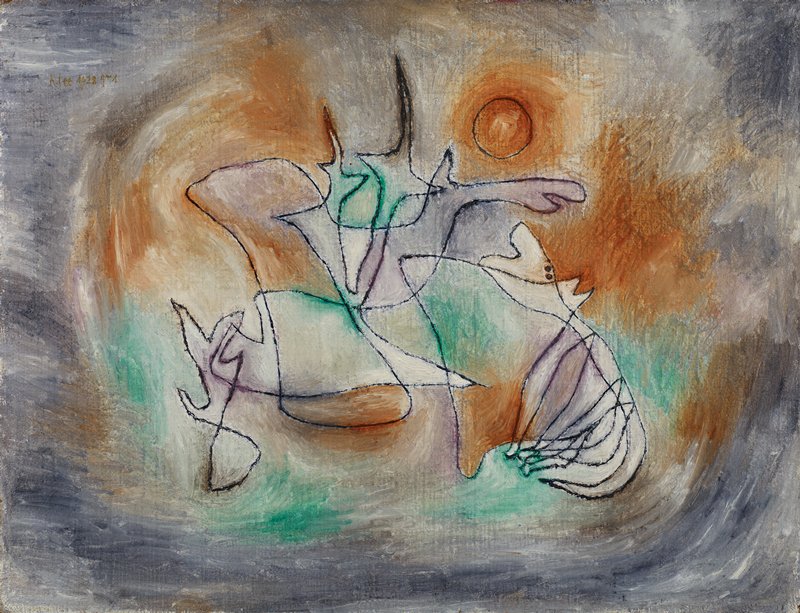
Fish Magic
Je k vidění?
Nevíme
Kde je teď „Fish Magic“? Sbírka: Muzeum umění ve Filadelfii, Philadelphia. Zda je dnes vystaveno, nevíme.
Philadelphia, Spojené státy americké
Vlastník je znám, dnešní vystavení nikoli.
- Tento stav platí od
- Zdroj
- Muzeum
O obrazu
Fish Magic is a 1925 Surrealist painting by Swiss-German artist Paul Klee. The painting belonged to the collection of Walter and Louise Arensberg before being donated in 1950 to the Philadelphia Museum of Art where it is currently held.
Podrobnosti
- Inventární číslo
- 1950-134-112
V katalogu
Zdroje
- Wikidata
- Obrázek: Muzeum umění ve Filadelfii — Paul Klee · Public domain · Wikimedia Commons
V životě: Paul Klee
Celý životopis1921–1931
The preliminary course on the “theory of form”
Klee developed a preliminary course in the “theory of form” that began with the “point as the beginning of all beginnings”, moving through space, and the “cosmic egg” from which line, spiral, square, circle and cube are born. Students listened to lectures illustrated with Klee’s own abstract watercolours and then painted their own, trying to express movement, balance, flight and tension.
1923
Galka Scheyer and the “Blue Four”
At the instigation of Galka Scheyer the “Blue Four” was formed — Klee, Kandinsky, Lyonel Feininger and Alexej von Jawlensky. Scheyer subsequently organised exhibitions of their work in the United States.
26 January 1924
The lecture “On Modern Art” in Jena
At his exhibition at the Kunstverein in Jena Klee delivered the lecture “On Modern Art” (Über moderne Kunst).
1924–1925
Success with the Paris Surrealists
In 1924 Klee exhibited in Paris for the first time and became a hit with the French Surrealists, who were drawn to his partly morbid motifs. At the Paris Surrealist exhibition of 1925 Max Ernst was impressed by his work.
1925
Moving to Dessau with the Bauhaus
In 1925 the Bauhaus moved to Dessau, and Klee moved with the school.
1925
“Pedagogical Sketchbook” is published
Klee’s theoretical book “Pedagogical Sketchbook” (Pädagogisches Skizzenbuch) is published; five years earlier, in 1920, his essay “Schöpferische Konfession” had appeared.