 Paul GauguinFrancie, 1848–1903
Eve
Je k vidění?
Momentálně není vystaveno
Kde je teď „Eve“? Sbírka: Clevelandské muzeum umění, Cleveland. Momentálně není vystaveno. Ověřeno 16. listopadu 2026.

Cleveland, Spojené státy americké
Patří do sbírky, ale momentálně není vystaveno.
- Ověřeno
- Tento stav platí od
- Zdroj
- Muzeum
O díle
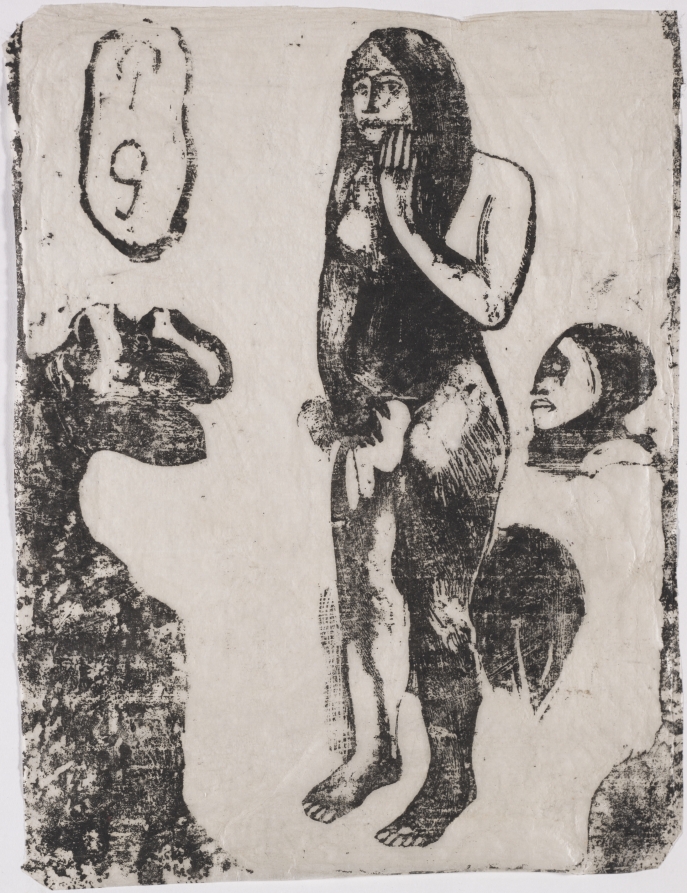
Paul Gauguin’s Eve, cut in wood in 1898–99, is in the Cleveland Museum of Art, Cleveland. Her modest gesture recalls images of the expulsion from Eden, but the hovering hooded head and rat belong to Tahitian imagery of spirits and death. Gauguin combined Christian and Polynesian signs across fourteen woodcuts conceived as visual fables. This impression is the sole known example of the first state. Before the block was altered, the dark area at lower right remained empty; extra white marks appear on Eve and the rat.
Slovy muzea
In his quest to reconcile the Gospels of the New Testament with the spirit of modern science, Gauguin created 14 woodcuts that mix Christian and Polynesian imagery to create the visual equivalents of parables or fables. Here, Eve’s gesture of modesty recalls earlier representations of her expulsion from the Garden of Eden, but the disembodied hooded head, the tupapau (a Tahitian evil spirit), and the rat (the shadow of a ghost) are Polynesian symbols. Combining Eve, an image of guilt and violation, with Tahitian symbols of death increases the potency of the scene. This special impression of Eve is the only known example of the first state in which the black shape in the lower right is blank, before the block was changed; additional white lines appear on Eve and the rat.
Clevelandské muzeum umění
Podrobnosti
- Inventární číslo
- 1991.158
V katalogu
Zdroje
- Clevelandské muzeum umění
- Obrázek: Clevelandské muzeum umění — Museum open access
V životě: Paul Gauguin
Celý životopis1891–1901 · Působiště
Tahiti
1897
News of the Death of His Daughter Aline
In April 1897 Gauguin received news that his beloved daughter Aline had died of pneumonia; the same month he learned that he had to vacate his house, and, taking out a bank loan for a new one, by the end of the year he was on the brink of ruin and despair.
c. 1898
Suicide Attempt
After finishing Where Do We Come From? What Are We? Where Are We Going?, Gauguin attempted suicide by taking arsenic, but the dose proved too large, and a violent fit of vomiting saved his life.
1899
Son born: Emile Gauguin
1899
Birth of a Son by Pahura
In 1899 the artist's Tahitian lover Pahura bore him a son; the painting Women by the Sea (Maternity) is associated with this event.
16 September 1901
Move to Hiva Oa, the House of Pleasure
On 16 September 1901 Gauguin arrived at Atuona on the island of Hiva Oa (Marquesas Islands), where he bought a plot from the Catholic mission and built a two-story house he named the Maison du Jouir ("House of Pleasure"). Here, despite illness and poverty, he worked at full strength — painting landscapes, writing stories, and engaging in journalism.