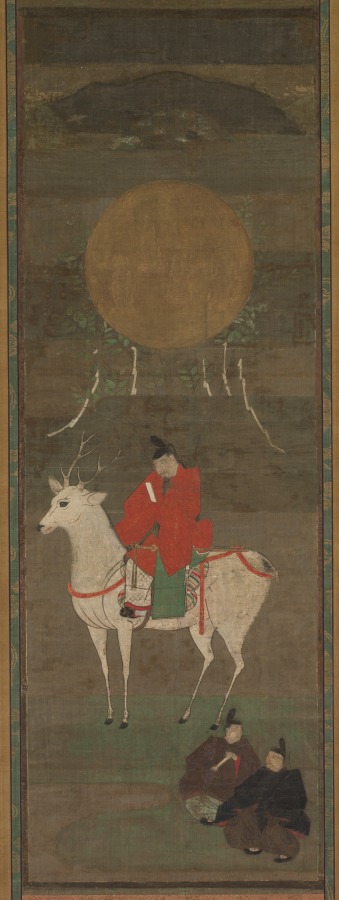
Departure from Kashima
Je k vidění?
Momentálně není vystaveno
Kde je teď „Departure from Kashima“? Sbírka: Clevelandské muzeum umění, Cleveland. Momentálně není vystaveno. Ověřeno 9. listopadu 2026.

Cleveland, Spojené státy americké
Patří do sbírky, ale momentálně není vystaveno.
- Ověřeno
- Tento stav platí od
- Zdroj
- Muzeum
O obrazu
Takemikazuchi rides a white deer in Departure from Kashima, painted in 1336–92 and now at the Cleveland Museum of Art in Cleveland. The deity travels from Kashima to his new home on Mount Mikasa in Nara. Five Kasuga gods appear within a gold circle supported by a sakaki tree. White paper strips signify the purity of five shrine halls, while flowering wisteria refers to the Fujiwara family. Beside the deer walk the brothers Nakatomi no Tokifū and Hidetsura, the younger of the two, who followed the deity and became priests at Kasuga Taisha.
Slovy muzea
The kami Takemikazuchi from Kashima (in present-day Ibaraki Prefecture) departs on a white deer for Mount Mikasa in Nara, where he takes up residence. The five Kasuga kami are presented within a golden circle supported by the branches of a sakaki tree, from which trail five white paper streamers—indicating the purity and sacredness of the five shrine halls of the complex—as well as blossoming wisteria vines, a symbol of the Fujiwara family. The two figures walking along near the stag’s back legs are Nakatomi no Tokifū and his younger brother Hidetsura, who have followed Takemikazuchi and become priests of Kasuga Taisha.
Clevelandské muzeum umění
Podrobnosti
- Inventární číslo
- 1917.93
V katalogu
Zdroje
- Clevelandské muzeum umění
- Obrázek: Clevelandské muzeum umění — Museum open access