Vasily KandinskyFrancie, 1866–1944
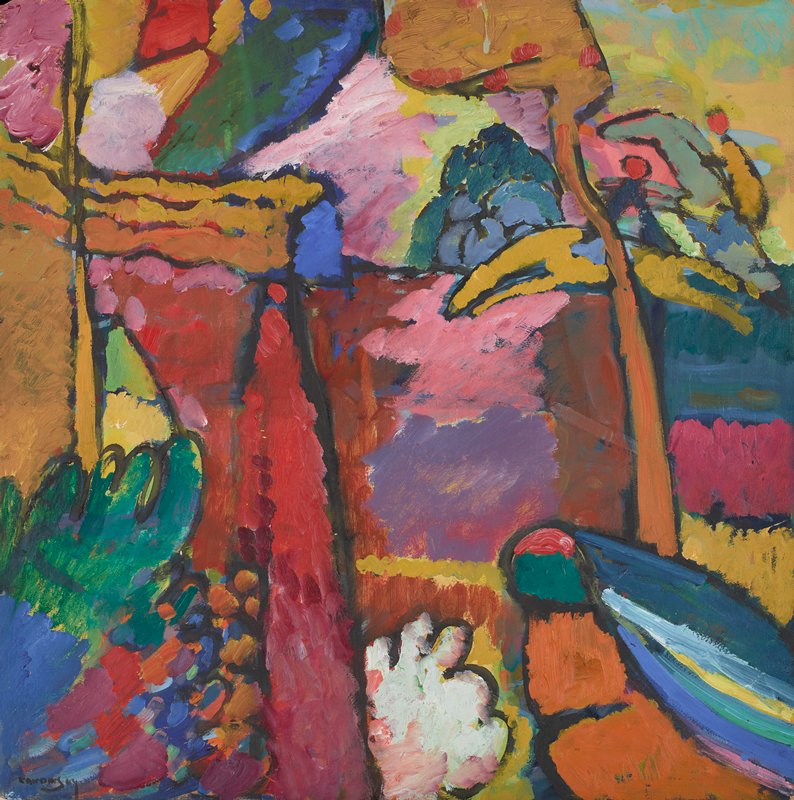
Blue Mountain
Je k vidění?
Nevíme
Kde je teď „Blue Mountain“? Sbírka: Guggenheimovo muzeum, New York. Zda je dnes vystaveno, nevíme.
New York, Spojené státy americké
Vlastník je znám, dnešní vystavení nikoli.
- Tento stav platí od
- Zdroj
- Muzeum
O obrazu
Blue Mountain, dated 1908, is an oil painting by Wassily Kandinsky in the Solomon R. Guggenheim Museum, New York. The horse and rider belong to a recurring motif in his work, from folk-inspired images to increasingly abstract landscapes. For Kandinsky, the rider expressed a wish to change artistic conventions and move towards a more spiritual future. The canvas measures 107.3 × 97.6 cm.
Podrobnosti
- Inventární číslo
- 41.505
V katalogu
Zdroje
- Wikidata
- Obrázek: Guggenheimovo muzeum — Vasily Kandinsky · Public domain · Wikimedia Commons
V životě: Vasily Kandinsky
Celý životopis1906–1908
Years of travel across Europe; the Blue Rose
From 1906 to 1908 Kandinsky travelled a great deal across Europe, was an associate of the Moscow symbolist group the Blue Rose, and then settled in the small Bavarian town of Murnau.
1908–1909
“Thought-Forms” and the Theosophical Society
In 1908 Kandinsky bought a copy of “Thought-Forms” by Annie Besant and Charles Webster Leadbeater, and in 1909 he joined the Theosophical Society.
1908–1909
Murnau and Münter's “Russian House”
Gabriele Münter bought a summer house in Murnau, where the couple happily entertained colleagues; it is still known as the “Russenhaus”. Later Münter used its basement to hide many works by Kandinsky and others from the Nazis.
1909
President of the Neue Künstlervereinigung München
Kandinsky helped found the Neue Künstlervereinigung München and became its president. The group dissolved in late 1911: it could not reconcile the radical approach of Kandinsky and others with conventional ideas of art.
1909
Budapest: Unkovskaya's system of colour hearing
At the Theosophical Congress in Budapest Kandinsky heard Aleksandra Unkovskaya present her system of music education based on sound-to-colour synesthesia; it led to his own discoveries, and he formulated the chain “emotion — sensation — the work of art — sensation — emotion”.
1910–1911
The treatise “Concerning the Spiritual in Art”
The treatise defended and promoted abstract art and affirmed that all forms of art are equally capable of reaching spirituality; colour in a painting can be autonomous, apart from the depiction of an object. Kandinsky distinguished three kinds of painting: impressions, improvisations and compositions.